The thermostat reads 75 degrees. The system is running. The house still feels like a sauna.
If you have lived through a Rock Hill July, you know what we are talking about. The number on the wall does not always match how the air actually feels, because South Carolina cooling is a two-part problem: dropping the temperature and pulling moisture out of the air. When either side fails, your house gets that sticky, mildewy summer feel even when the AC has not stopped running.
Here are the six causes we diagnose most often when Rock Hill, Fort Mill, and Tega Cay homeowners call about an AC that runs but does not cool.
1. The Air Filter Is Clogged
This is the most common cause and the easiest to fix. Carolina pollen, dust, and pet dander load filters fast. When the filter restricts airflow, the system cannot move enough warm air across the evaporator coil to do its job. You get warm air at the vents, longer run times, and rising humidity.
Pull the filter. If you cannot see light through it, replace it. In peak pollen weeks (March through May, and again in late August), check it every 30 days. Outside those windows, every 60 to 90 days.
2. The Outdoor Condenser Is Dirty or Blocked
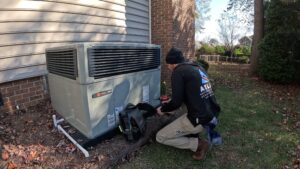
The condenser is the box outside that rejects heat to the air. If the fins are caked with grass clippings, cottonwood, or pollen, the system cannot dump heat fast enough. You feel it as weak cooling and rising electric bills.
Walk outside. Look at the fins. If they are obviously dirty, hose them down gently from the inside out. Clear at least 18 inches of space all around the unit. Trim back shrubs. Move the patio furniture you parked next to it last fall.
3. The System Is Low on Refrigerant
Refrigerant does not get “used up.” If your system is low, you have a leak. That leak might be at a flare fitting, in the evaporator coil, in the condenser coil, or anywhere along the line set.
Signs of low refrigerant:
- Vents blow cool air but not cold air, even after 30 minutes of running.
- You hear a hissing or bubbling sound near the indoor coil.
- Ice forms on the larger copper line outside, or on the indoor coil.
- Electric bills are up 20%+ from this time last year.
Topping off the refrigerant without finding the leak is a $200 to $400 band-aid that will leak out again. We always locate and repair the leak first, then evacuate and recharge to the manufacturer specification.
4. The Evaporator Coil Is Frozen
Yes, your AC can freeze in 95-degree weather. Either a dirty filter, dirty coil, or low refrigerant drops coil temperature below freezing, and humidity in the air solidifies on the surface. Once the coil is iced, no heat transfer happens. The result: warm air at the vents and a slowly thawing block of ice on top of your air handler.
If you suspect this, switch the thermostat to Off, the fan to On, and read our step-by-step thaw guide. Do not keep running it. You will damage the compressor.
5. The System Is Undersized for Carolina Humidity
This one is heartbreaking and we see it more than we should. Someone installed a system years ago based on square footage alone, without a proper Manual J load calculation, and the equipment cannot handle Rock Hill summer loads. The system runs constantly, never satisfies the thermostat by more than a degree or two, and humidity creeps up because short runs do not give the coil time to dehumidify.
You cannot fix undersizing with refrigerant or filters. If your house has always struggled in July and August, even when the system is brand new and serviced, it may be undersized. We can run a proper load calculation and give you the math.
6. The System Is Oversized for Carolina Humidity
The opposite problem, just as bad. An oversized AC cools the air temperature to setpoint in 6 to 8 minutes, then shuts off. That is not long enough for the coil to pull serious moisture out of the air. The thermostat reads 75 degrees, the air contains 65% humidity, your skin is sticky.
The cure here is a properly-sized replacement or, in some cases, a variable-speed system that can run at lower capacity for longer cycles. Either path starts with an honest Manual J calculation, not a guess.
Quick Checklist Before You Call
Run this 5-minute check before scheduling service. About one in four “AC not cooling” calls is solved by these steps:
- Set the thermostat to Cool, the fan to Auto, and the temperature 4 degrees below the current room temperature.
- Replace the air filter if it has been more than 60 days.
- Walk to every supply vent and confirm it is open.
- Walk to every return grille and confirm it is not blocked.
- Walk outside, clear debris from the condenser, hose the fins gently.
- Let the system run for 60 minutes. Check supply air temperature with a thermometer. You want a 15 to 22 degree drop from return air to supply air.
If supply air is less than 12 degrees cooler than return air after 60 minutes, the system needs professional service.
What to Expect from an Atlas Diagnostic
An $89 diagnostic visit gets a licensed technician on site, the full system tested with refrigerant gauges and a thermal imaging check on the coil, and a flat-rate written quote before any repair starts. Approve the repair and the $89 rolls into the bill. Same-day and next-day appointments across Rock Hill, Fort Mill, Tega Cay, Lake Wylie, York, Clover, and Indian Land.
Call (803) 839-0020 or request service online. No pressure to replace anything that can be honestly repaired.
More from Air Conditioning Guides
- Frozen AC Coil: What to Do (Step-by-Step for Rock Hill Homeowners)
- Thermostat Not Working? Fix-First Checks Before You Assume Your AC Failed
- AC Repair vs Replacement: A Rock Hill Homeowner’s Decision Guide
- Single-Stage vs Two-Stage vs Variable-Speed AC
- SEER Ratings Explained for Rock Hill Homeowners
- R-454B Refrigerant Explained: What the R-410A Phase-Down Means for Your Home AC
- How Long Does an AC Unit Last in South Carolina?
- AC Capacitor Failure Signs Every Rock Hill Homeowner Should Know
Explore Air Conditioning Guides
Related service: AC Repair in Rock Hill, SC