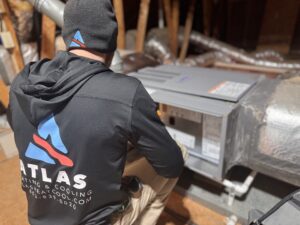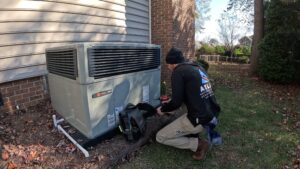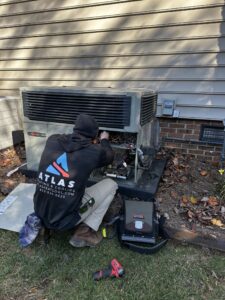
Your AC just got diagnosed with an $1,800 repair. The technician asked if you want to proceed or talk about replacement. Most homeowners stare at that question with no real framework to answer it. Here is the framework we use at Atlas Heating & Cooling, in plain English, so you can decide on the math instead of the sales pressure.
Rule 1: The $5,000 Rule
The most common industry rule of thumb. Multiply the age of your AC by the cost of the proposed repair. If the result exceeds $5,000, replacement usually wins.
The logic: a higher product means you are putting significant repair dollars into older equipment, when those dollars would be better spent on new equipment that lasts 12 to 15+ more years.
Examples for Rock Hill:
- 14-year-old system, $850 repair: 14 × $850 = $11,900. Replace.
- 6-year-old system, $400 repair: 6 × $400 = $2,400. Repair.
- 10-year-old system, $1,200 repair: 10 × $1,200 = $12,000. Replace.
- 9-year-old system, $475 repair: 9 × $475 = $4,275. Borderline, lean repair.
Rule 2: The 50% Rule
Alternative framing. If a single repair costs more than 50 percent of a new system installed, replace.
In Rock Hill, a typical residential AC replacement runs $7,500 to $14,000 depending on size, efficiency tier, and any duct or electrical work. So a $4,500 repair on a $9,000 replacement is right at the line. A $5,500 repair is past it, even on a relatively newer system.
Rule 3: System Age and Lifespan
HVAC manufacturers publish 12 to 18 year lifespans. In Rock Hill’s heavy cooling climate, real-world AC lifespans run 10 to 15 years. Hard ceiling considerations:
- Under 8 years: Repair almost always wins unless the repair cost is catastrophic.
- 8 to 12 years: Apply the $5,000 rule and the 50% rule. Either can tip it.
- 12 to 15 years: Replacement is usually the smarter long-term move, even for moderate repair costs.
- 15+ years: Replace. Putting significant money into equipment near the end of life is throwing it away.
Rule 4: R-22 Refrigerant Disqualifier
If your AC uses R-22 refrigerant (also called Freon), the math shifts hard toward replacement. R-22 has been phased out under the Montreal Protocol. It is no longer manufactured, only reclaimed, and bulk pricing has climbed from $80/lb to over $200/lb in recent years.
A 3-ton R-22 system that needs a recharge can need 6 to 9 pounds, putting refrigerant cost alone at $1,200 to $1,800 on top of any repair labor. Most R-22 systems are 12+ years old anyway, which makes this rule and the age rule pile up against repair.
If your data plate says R-22, plan for replacement on the next significant failure.
Rule 5: Repair History
Two repairs in the same season is a yellow flag. Three or more repairs in 18 months is a red flag.
Components rarely fail in isolation on older systems. A blower motor failure today is often followed by a capacitor failure six weeks later, followed by a contactor failure six weeks after that. Each call costs you $89 in diagnostic plus repair labor. Three of those in a row often costs more than a replacement and you still have the same aging system.
Rule 6: Energy Bill Trend
Pull your power bills for the same month over the last 3 years. If July is up 25 percent or more year-over-year and your usage has not changed, your AC is losing efficiency, often from compressor wear, refrigerant loss, or coil fouling.
New systems running 16 to 18 SEER2 can cut cooling costs 20 to 35 percent versus a worn-out 10-SEER unit. Over 12 years of equipment life, that adds up to a meaningful number that should factor into the replacement decision.
Rule 7: The Compressor Question
The compressor is the most expensive part of an AC. Compressor failures on a system 10+ years old are almost always replace, not repair, even though the compressor itself is sometimes covered under warranty.
Why: even with a free compressor under warranty, the labor to replace it runs $1,800 to $2,800 in Rock Hill. You are putting that into a system that has multiple other aging parts ready to fail. Spend that labor cost as a down payment on new equipment instead.
Rule 8: The Indoor Coil Match
Modern AC efficiency depends on the outdoor condenser and indoor evaporator coil being matched. If your indoor coil is 8 years old and your outdoor condenser dies, replacing only the outdoor unit creates a mismatched system that will not perform to spec and may not be eligible for full manufacturer warranty.
Practical rule: if both halves of the system are over 10 years old and one fails, replace both.
Rule 9: Comfort and Humidity
If your house has always struggled with humidity, persistent hot rooms, or uneven cooling, those are sizing or system design issues. A repair will not fix them. A properly-sized variable-speed replacement will.
If you would not buy your current system again knowing what you know now, a major repair on it is bad money.
When Repair Always Wins
Some repairs are no-brainers regardless of age:
- Capacitor replacement on any system under 12 years old.
- Contactor replacement on any system under 12 years old.
- Thermostat replacement.
- Condensate pump or float switch.
- Small refrigerant leak repair on a younger system with R-410A.
- Any repair under $400 on a system under 10 years old.
The Atlas Standard: Both Numbers, Both Times
When you have a borderline case, an Atlas technician will give you both the repair quote and a rough replacement quote in writing. No pressure to pick the bigger number. We are happy to repair a 7-year-old system for $400 and not see you again for 18 months. We are also happy to replace a 13-year-old system that has been nickel-and-diming you. Either way, the math is on paper.
For real-world repair pricing, see our average AC repair cost guide. For replacement timeline details, see our installation timeline.
Get an Honest Assessment
If you are weighing a major AC repair against replacement, call (803) 839-0020 or request a consultation. Same-day diagnostics across Rock Hill, Fort Mill, Tega Cay, Lake Wylie, York, Clover, and Indian Land. Written quotes, honest math, no high-pressure replacement pitch.
More from Air Conditioning Guides
- Single-Stage vs Two-Stage vs Variable-Speed AC
- SEER Ratings Explained for Rock Hill Homeowners
- R-454B Refrigerant Explained: What the R-410A Phase-Down Means for Your Home AC
- How Long Does an AC Unit Last in South Carolina?
- AC Capacitor Failure Signs Every Rock Hill Homeowner Should Know
- AC Not Cooling Enough? Why South Carolina’s Humid Summer Is Killing Your System
- Frozen AC Coil: What to Do (Step-by-Step for Rock Hill Homeowners)
- Thermostat Not Working? Fix-First Checks Before You Assume Your AC Failed
Explore Air Conditioning Guides
Related service: AC Installation in Rock Hill, SC