Spring is the window. By the time temperatures crack 90 in Rock Hill, our schedule is already jammed with no-cooling calls and we cannot get to every tune-up request. Get ahead of the rush by running through this checklist in March or early April.
Here is the full spring AC tune-up checklist, divided into what a homeowner can safely do and what a licensed technician should handle.
DIY Spring AC Checklist
Set aside 30 to 45 minutes on a weekend. No special tools required.
1. Replace the Air Filter
If your filter has been in over 60 days, replace it now. Rock Hill pollen is about to load it down anyway. Note the size on the existing filter (something like 16x25x1 or 20x25x4) and keep two spares on hand.
2. Clear Around the Outdoor Condenser
Walk outside to the AC condenser. Look for:
- Leaves, sticks, or debris packed against the fins or piled on top of the unit.
- Mulch, dirt, or grass clippings sitting on the bottom panel.
- Shrubs or branches within 18 inches of the unit.
- Anything you stored next to it over the winter (snow shovels, patio furniture, the kids’ bikes).
Clear at least 18 inches of space all around. Pull weeds. Cut back any shrubs that have crept close.
3. Hose Off the Condenser Fins
Turn the AC off at the disconnect switch (or at the breaker if no disconnect is visible). With a regular garden hose on a gentle setting, spray from the inside of the unit out, top to bottom. Never use a pressure washer. Bent fins are an expensive lesson and they reduce efficiency permanently.
If the fins look badly fouled or bent, leave it for the technician to handle with a coil cleaner and a fin comb.
4. Check All Indoor Supply Vents
Walk the house. Confirm every supply vent is open and unblocked. Closing vents in unused rooms is a common DIY mistake that starves the coil and causes freezing. Open them all, even in spare bedrooms.
5. Check All Return Grilles
Find every return grille. Make sure nothing is blocking them: furniture, drapes, rugs. Vacuum any dust or pet hair off the grille face.
6. Test the Thermostat
- Set to Cool, fan to Auto.
- Set the temperature 3 degrees below current room temperature.
- System should start within 60 seconds.
- Replace thermostat batteries if applicable. Most thermostat “failures” are dead batteries.
7. Listen and Feel
Let the system run for 15 minutes. Then:
- Feel the supply air at a vent. Should be noticeably cooler than the return air.
- Listen at the outdoor unit. Should be a steady hum, not buzzing, screeching, or vibrating loudly.
- Look at the outdoor copper suction line (the larger insulated one). Should be cool and possibly slightly damp from condensation, not iced over.
If any of those are off, write down what you observed for the technician.
Professional Spring AC Tune-Up Checklist
These items require specialized tools, refrigerant handling certification, and the trained eye that catches early-stage failures. Here is what an Atlas spring tune-up includes:
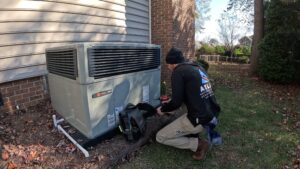
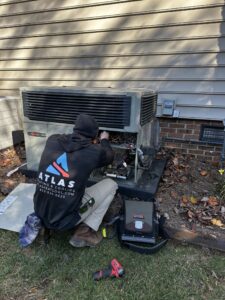
Outdoor Unit (Condenser)
- Foaming coil cleaner applied to outdoor condenser, then rinsed fins-out.
- Refrigerant pressure check on high side and low side, compared against the manufacturer charge spec for the current outdoor temperature.
- Capacitor microfarad test with a meter. Replace any cap reading below 90 percent of rated value.
- Contactor visual inspection for pitting and arc damage.
- Compressor amp draw measured against nameplate spec.
- Outdoor fan motor amp draw measured.
- Disconnect and outdoor electrical connections tightened.
- Surge protector status checked if installed.
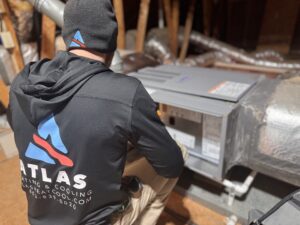
Indoor Unit (Air Handler or Furnace Coil)
- Evaporator coil inspected for fouling and biofilm.
- Blower wheel inspected and cleaned if accessible.
- Blower motor amp draw verified.
- Condensate pan and drain line flushed with nitrogen or vacuum.
- Condensate safety float switch tested.
- Algae prevention tablet placed in pan.
- Filter replaced (or verified clean if you handle filters).
- Indoor electrical connections tightened.
System Performance
- Temperature split across the coil measured. Target 15 to 22 degrees from return to supply.
- Thermostat calibration verified.
- Cycle time observed and validated.
- Static pressure measured at the air handler if airflow concerns exist.
- Overall system efficiency assessed against expected SEER for outdoor conditions.
Documentation
- Written report of system condition.
- Photos of any issues found.
- Flat-rate quote for any wear items that should be addressed.
- Recommendations for the next 12 months.
A real Atlas tune-up takes 45 to 75 minutes on site. Anyone in and out in 15 minutes did not actually do the work.
The 5 Most Common Spring Findings
On spring tune-ups for systems that have not been serviced in 12+ months, here is what we typically find:
- Weak capacitor running 10 to 20 percent below rated microfarads. Replacement now ($175-300) prevents a no-cooling call in July.
- Refrigerant charge slightly low. Could be a slow leak, could be from sloppy past service. We flag it for monitoring.
- Condenser coil fouled. Cleaning restores 10 to 20 percent of efficiency.
- Condensate line on the verge of blockage. A clog mid-summer means water in the ceiling.
- Loose electrical connection at the contactor or disconnect. Tightening prevents arc damage.
Each of these caught in March is a $0 to $300 fix. Caught in August it is an emergency rate, a damaged compressor, or a flooded ceiling.
The Easier Path: Atlas Assurance
Our Atlas Assurance maintenance membership handles spring AC and fall furnace tune-ups automatically. We call to schedule, we keep your service history, and you get priority booking when the weather turns plus 15 percent off any repairs that come up.
For more context on how often AC needs service, see how often to service AC in South Carolina.
Book Your Spring Tune-Up
Spring slots fill fast. Call (803) 839-0020 or book online. Atlas Heating & Cooling serves Rock Hill, Fort Mill, Tega Cay, Lake Wylie, York, Clover, and Indian Land. Honest, thorough, no upsell pitch.
More from Maintenance & Home Comfort
- Rock Hill, SC Climate HVAC Considerations Every Homeowner Should Know
- How Often to Change Your AC Filter: A South Carolina Homeowner’s Guide
- Indoor Air Quality Tips for Humid Carolina Homes
- How Often Should Your AC Be Serviced in South Carolina?
- Fall Furnace Tune-Up Checklist for Rock Hill Homeowners
- Commercial HVAC Maintenance Schedule for Rock Hill Businesses
Explore Maintenance & Home Comfort
Related service: AC Maintenance in Rock Hill, SC