Homeowners in Smiths and across Rock Hill are seeing summer electric bills spike 40-60% above winter months, with many paying $300-400 monthly during peak cooling season. A professional AC audit can identify specific energy drains that homeowners miss during basic maintenance checks.
What to Do About High Summer Electric Bills in Rock Hill
- Check your Duke Energy usage history online to compare this summer’s kWh consumption to last year’s same months
- Walk around your home at 10 AM and 2 PM to feel for warm spots near windows, doors, and outlet covers
- Measure the temperature difference between your thermostat setting and actual room temperature using a separate thermometer
- Document which rooms feel significantly warmer or cooler than others during peak afternoon hours
- Note whether your AC runs constantly or cycles on and off every 10-15 minutes during 90+ degree days
- Schedule a professional energy audit before August when HVAC companies get swamped with emergency calls
Your AC Unit is Oversized or Undersized for Rock Hill’s Climate

Most homes in established Rock Hill neighborhoods like Oakland and Cherry Park were built between 1960-1990, when HVAC sizing calculations were less precise. An oversized AC unit cycles on and off too frequently, never running long enough to remove humidity from your home. This makes your house feel muggy, prompting you to lower the thermostat further. Atlas technician John regularly finds 4-ton units in 1,800 square foot homes that need only 3 tons of cooling capacity.
According to South Carolina’s residential energy code, proper AC sizing requires Manual J load calculations that factor in Rock Hill’s 91°F design temperature and 76°F wet bulb conditions. An undersized unit runs constantly during July and August, when Rock Hill averages 15-20 days above 90°F.
Atlas Heating & Cooling performs detailed load calculations during their AC energy audits, measuring actual square footage, insulation levels, and window orientations. Their factory-trained technicians use specialized software that accounts for Rock Hill’s specific climate data, ensuring replacement systems match your home’s actual cooling needs rather than guesswork.
Ductwork Problems Hidden in Crawl Spaces and Attics
Rock Hill’s clay soil and seasonal ground movement cause foundation settling that can disconnect or damage ductwork over time. Atlas technician Stephen encounters disconnected ducts in 40% of homes built in areas like India Hook and Ebenezer, where expansive clay soil shifts with moisture changes. A single disconnected supply duct dumps conditioned air into your crawl space, forcing your AC to run 50-70% longer to maintain indoor temperatures.
Manual D duct design standards require properly sized return air ducts, but many older Rock Hill homes have inadequate return airflow. Atlas uses digital manometers during AC audits to measure actual airflow at each register, identifying restrictions that force your system to work harder. Common problems include crushed flexible ducts in tight crawl spaces and return ducts that are 30-40% smaller than current code requirements.
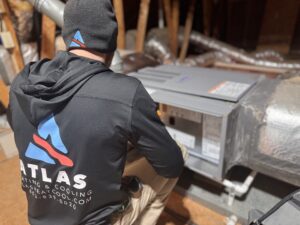
Ductwork in Rock Hill attics faces extreme temperature swings, with summer attic temperatures reaching 140°F. Their comprehensive duct assessment includes thermal imaging to identify hidden air leaks and pressure testing to quantify total duct leakage.
Understanding Energy Audits for AC Systems in York County
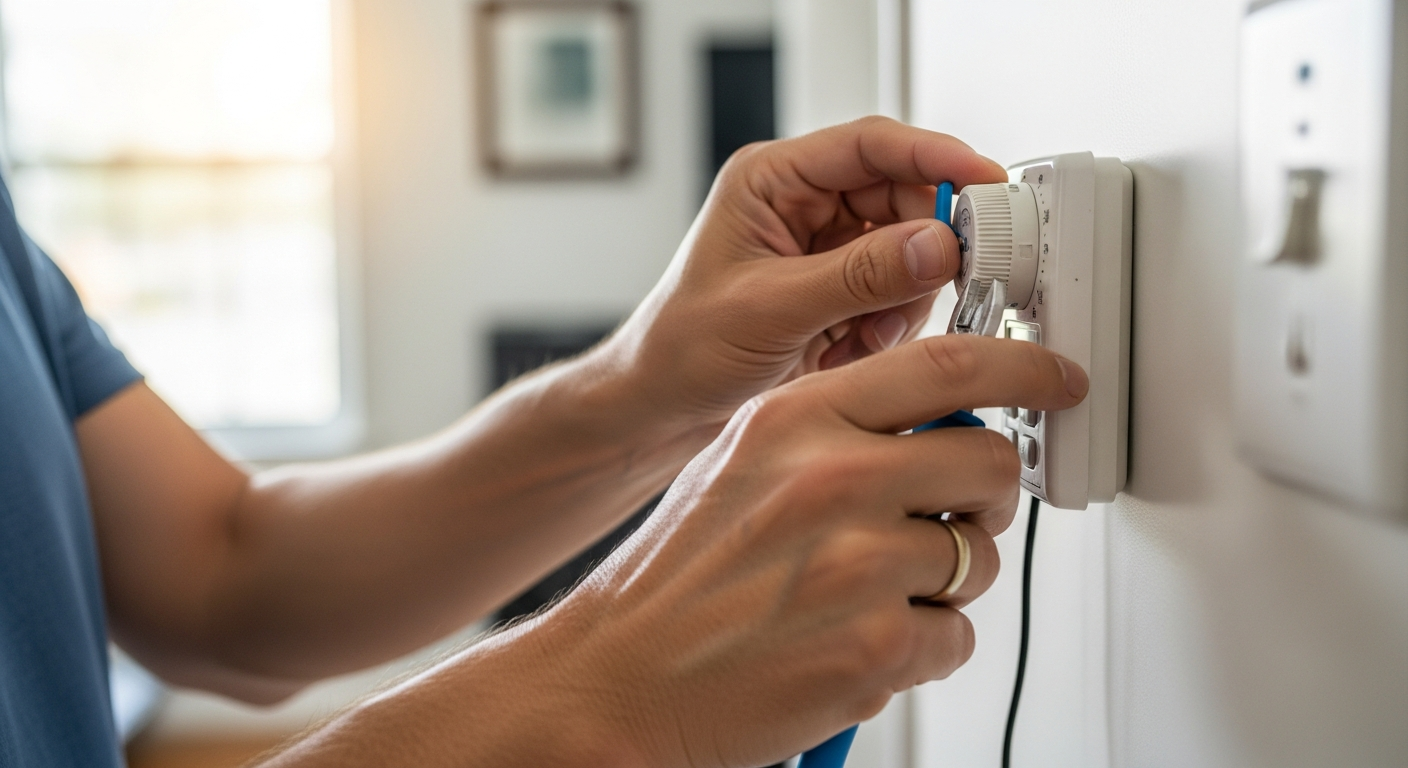
A professional HVAC efficiency assessment goes beyond changing filters and checking refrigerant levels. Atlas Heating & Cooling’s AC audit process includes blower door testing to measure your home’s air tightness, thermal imaging to identify insulation gaps, and combustion analysis for homes with gas heating systems. Their technicians use calibrated digital instruments to measure actual airflow, temperature differentials, and electrical consumption rather than relying on visual inspections.
ASHRAE standards specify that properly functioning AC systems should maintain a 16-22°F temperature split between supply and return air, but systems with refrigerant leaks or dirty coils often show splits outside this range.
The audit includes detailed documentation of your home’s thermal envelope, including wall insulation levels, attic insulation depth, and window performance ratings. Atlas provides a written report with specific recommendations ranked by energy savings potential and payback period, helping you prioritize improvements that will reduce your summer electric bills most effectively.
Home Insulation Impact on Cooling Costs in Rock Hill
Many Rock Hill homes built before 1980 have minimal wall insulation and outdated attic insulation that has settled or been disturbed by pest control treatments.
Department of Energy data shows that proper insulation can reduce cooling costs by 15-50% in southern climates. During AC audits, Atlas uses thermal imaging cameras to identify specific areas where conditioned air escapes through inadequate insulation. Common problem areas include knee walls in bonus rooms, cantilevers over garages, and attic access hatches that lack proper sealing.
Rock Hill’s humid summers make air sealing equally important as insulation thickness. Atlas measures air infiltration rates during their audits, finding that many homes exchange indoor and outdoor air 8-12 times per hour instead of the recommended 3-5 air changes. Sealing air leaks around electrical outlets, recessed lights, and plumbing penetrations often provides immediate reductions in summer electric bills.
Optimal AC Thermostat Settings for Summer in South Carolina
The EPA’s Energy Star program recommends 78°F when you’re home during summer months, but Rock Hill’s humidity levels often make this temperature feel uncomfortable without proper system operation. Homeowners who set thermostats below 72°F during peak afternoon hours force their AC systems to run continuously, driving up electric bills without achieving better comfort.
During AC audits, Atlas measures actual humidity levels throughout your home using calibrated hygrometers. Properly functioning AC systems should maintain indoor humidity between 40-50% during summer months, but oversized systems or systems with airflow problems often fail to remove adequate moisture. This forces homeowners to set lower temperatures to achieve comfort, significantly increasing energy consumption.
Atlas recommends programmable or smart thermostats that automatically adjust temperatures based on occupancy and outdoor conditions. Their audits include analysis of your current thermostat programming and recommendations for optimal settings based on your home’s specific thermal characteristics and your family’s schedule patterns.
AC Energy Saving Tips Specific to York County Conditions

Rock Hill’s afternoon thunderstorms and high humidity create unique challenges for AC efficiency that generic energy tips don’t address. Atlas Heating & Cooling recommends closing south and west-facing blinds by 11 AM during summer months, when Rock Hill’s solar heat gain peaks. Their energy audits measure actual solar heat gain through different window orientations in your specific home.
During peak cooling season in July and August, Atlas advises running ceiling fans in occupied rooms to create air movement that allows comfortable temperatures 3-4°F higher than without fans. Lawrence Berkeley National Laboratory research confirms that ceiling fans can reduce AC energy consumption by 20-30% when used properly, but only in rooms where people are present.
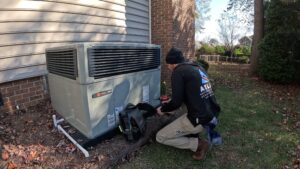
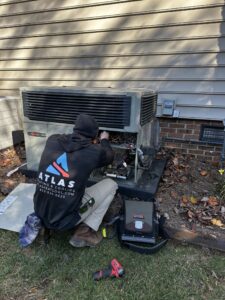
Atlas technician Stephen regularly finds outdoor AC units in Rock Hill that are shaded by landscaping or fencing, reducing efficiency by 10-15%. Their AC audits include evaluation of outdoor unit placement and airflow, with specific recommendations for improving heat rejection. Simple changes like trimming shrubs to maintain 18-inch clearance and washing outdoor coils can provide immediate energy savings.
Professional HVAC Assessment Process at Atlas Heating & Cooling
Atlas Heating & Cooling’s comprehensive AC audit takes 3-4 hours and includes testing that most homeowners cannot perform themselves. Their factory-trained technicians arrive with digital manometers, thermal imaging cameras, refrigerant manifold gauges, and electrical meters to measure actual system performance rather than making visual assessments.
The audit begins with detailed measurements of your home’s dimensions and thermal characteristics, including insulation levels, window types, and air leakage rates. This analysis often reveals that existing equipment is improperly sized for your home’s needs.
During system testing, Atlas measures refrigerant pressures, electrical consumption, airflow rates, and temperature differentials under actual operating conditions. Their technicians document specific problems like dirty evaporator coils, restricted airflow, or refrigerant leaks that cause your system to consume excess energy. The final report includes cost estimates for recommended improvements and projected energy savings based on current Duke Energy rates in York County.
Addressing high summer electric bills requires understanding the specific factors affecting your home’s cooling efficiency, from ductwork problems common in Rock Hill’s clay soil conditions to insulation deficiencies in older neighborhoods. Atlas Heating & Cooling’s detailed AC audit process identifies the root causes of energy waste rather than providing generic recommendations. Contact their experienced team at (803) 324-7017 to schedule a comprehensive energy assessment, or visit their AC maintenance services page to learn more about optimizing your system’s performance before peak summer heat arrives.
Frequently Asked Questions

How much does an AC audit cost in Rock Hill, and what’s included?
Atlas Heating & Cooling charges $150-200 for a comprehensive AC audit in Rock Hill, depending on your home’s size and system complexity. The audit includes blower door testing, thermal imaging, ductwork inspection, refrigerant pressure testing, and electrical consumption measurements. You receive a detailed written report with specific recommendations and projected energy savings based on current Duke Energy rates in York County.
What’s the average electric bill reduction after an AC audit in Smiths, SC?
Results depend on your home’s specific problems and which recommendations you choose to implement.
How long does it take to see savings after an AC audit and repairs?
Simple fixes like sealing duct leaks and adjusting thermostat settings provide immediate savings on your next electric bill. Larger improvements like adding insulation or replacing oversized equipment typically pay for themselves within 2-4 years based on Rock Hill’s cooling costs. Atlas provides specific payback calculations for each recommendation during your audit review meeting.