Steam rising off your outdoor unit on a cold morning is almost always the defrost cycle doing exactly what it was designed to do. It is not smoke, and the unit is not failing. The heat pump is briefly reversing itself to melt frost off the outdoor coil, and the vapor you see is that frost turning to water and evaporating.
The cycle is short, automatic, and comes with a set of sounds and sensations that look alarming the first winter you own a heat pump. This guide covers what normal defrost looks like, how long it should last, and the specific signs that separate it from actual icing, the condition that does need a technician.
What is the heat pump defrost cycle?
The defrost cycle is a short, automatic reversal that melts frost off the outdoor coil so the heat pump can keep pulling heat from the outside air. In heating mode, the outdoor coil runs colder than the air around it. When that air is cold and damp, moisture condenses on the coil and freezes. A frosted coil cannot absorb heat efficiently, so the system clears it.
For a few minutes, the heat pump runs the refrigerant backward, effectively switching to cooling mode outdoors, which sends warm refrigerant to the outdoor coil and melts the frost. Then it switches back to heating. InterNACHI’s technical description of how the reversing valve handles this covers the mechanics for anyone who wants them.
What does a normal defrost cycle look and sound like?
Normal defrost has a recognizable signature. You will typically notice several of these together:
- Steam or vapor rising off the outdoor unit, sometimes heavily
- A loud whoosh or clunk as the reversing valve changes direction
- The outdoor fan stopping while the compressor keeps running
- Cool or lukewarm air from the indoor vents for a few minutes
- An AUX or EM HEAT indicator lighting up on some thermostats
- Water running off the unit and onto the pad below
- Warm air returning once the cycle completes
The outdoor fan stopping while the compressor runs is the one that most often prompts a service call. It looks like a fan failure. During defrost it is intentional: running the fan would blow the heat away from the coil you are trying to thaw.
How long should the defrost cycle last, and how often?
A defrost cycle typically runs somewhere between five and fifteen minutes, and systems generally check for frost every thirty to ninety minutes while in heating mode. Lennox’s homeowner guidance describes a cycle of roughly that length as standard behavior.
How often it actually triggers depends on the weather, not on a fixed schedule:
| Conditions | What to expect |
|---|---|
| Cold and damp, near freezing | Frequent defrost cycles; this is the worst case for frost formation |
| Cold and dry | Infrequent, sometimes none at all |
| Well below freezing | Less frequent than near-freezing, since very cold air holds little moisture |
| Mild | Rare |
The near-freezing damp morning is the peak condition, and in the Carolinas that describes a lot of December and January. Frequent defrost cycles on those days are the system responding correctly to the weather.
How do you tell normal defrost from a real problem?
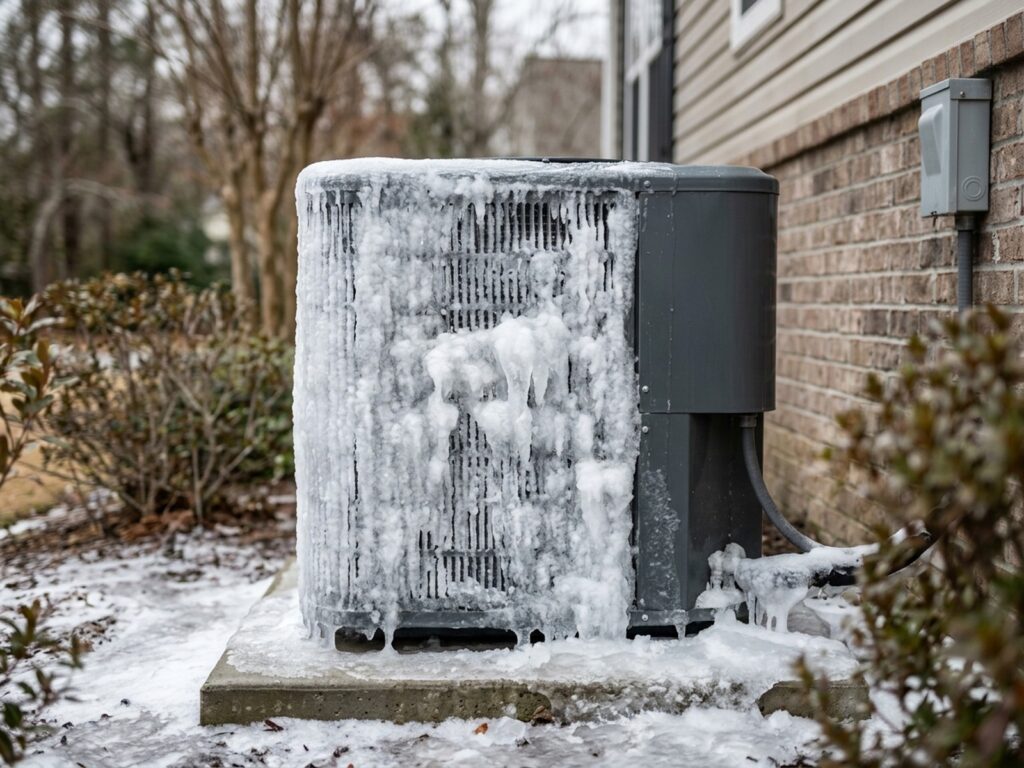
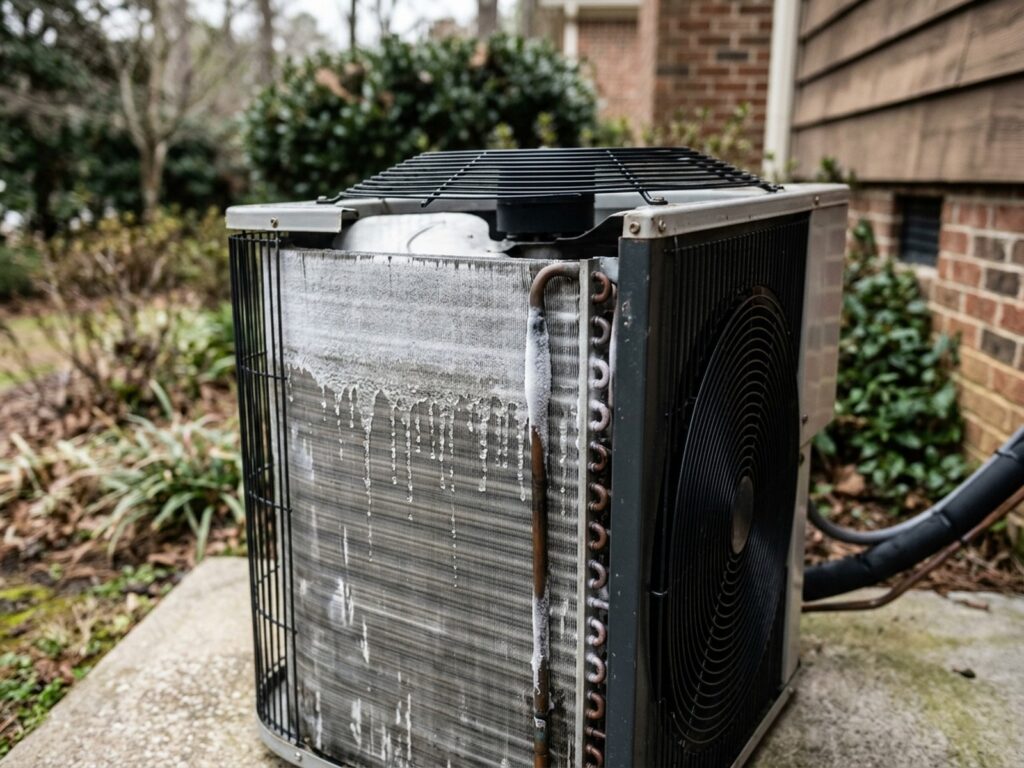
The difference is whether the ice clears and the heating recovers. Normal frost is thin, patchy, and gone after the cycle. A fault leaves ice behind.
| Sign | Normal defrost | Needs a technician |
|---|---|---|
| Ice on the coil | Light frost that clears each cycle | Thick ice that stays, or a solid encasing sheet |
| Duration | Five to fifteen minutes, then heat returns | Runs far longer, or cycles constantly without clearing |
| Indoor temperature | Holds or recovers to setpoint | Drifts down and does not recover |
| Ice location | Coil surface | Ice over the fan blades, the top of the unit, or built up underneath |
| After the cycle | Unit returns to normal heating | Refreezes within minutes |
| Sounds | One whoosh at each transition | Grinding, screeching, or ice striking the fan |
If the unit is encased in ice, do not chip at it. The coil fins bend easily and the refrigerant tubing runs right behind them. A screwdriver through a coil turns a defrost problem into a compressor replacement. Do not pour hot water over it either. Switch the system to EM HEAT so the house stays warm, and schedule service.
Our guide to a heat pump frozen in winter covers what causes persistent icing and what a technician checks.
Why does the indoor air feel cool during defrost?
Because the system is momentarily cooling outdoors, which means it is not heating indoors. Most heat pumps energize the backup electric heat strips during defrost specifically to offset this, so the air coming out of your vents is tempered rather than cold. Depending on the equipment and the thermostat’s programming, you may feel a few minutes of merely lukewarm air.
That is also why your thermostat may briefly display AUX or EM HEAT during defrost. Seeing it for a few minutes during a defrost cycle is normal. Seeing it run for hours is not. That points at a heating problem rather than a defrost event, and our explainer on auxiliary heat versus emergency heat covers the distinction and why it matters on your power bill.
Separately, heat pumps deliver gentler heat than a gas furnace even when working perfectly. Supply air in the 90s feels cool against skin that is around 98 degrees. If the air feels underwhelming but the house is holding temperature, that is normal heat pump behavior rather than a defrost issue. We cover that in heat pump blowing cold air.
What can you do to help the system defrost properly?
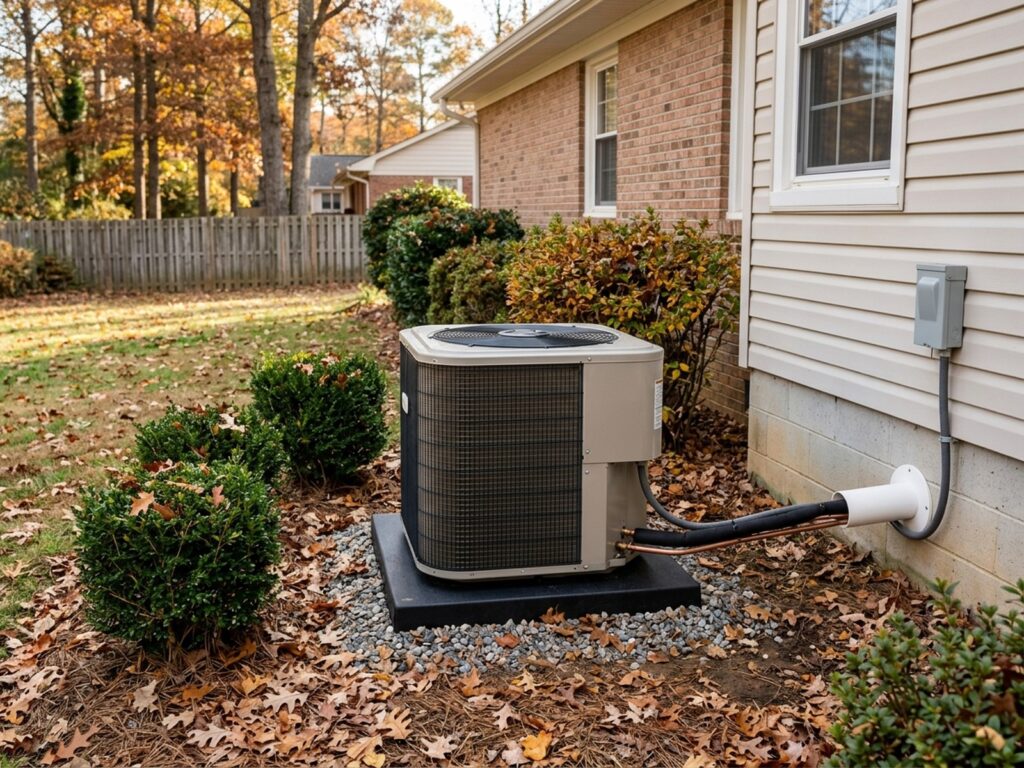
A few things are genuinely within your control:
- Keep the outdoor unit clear. Leaves, mulch, and yard debris against the coil restrict airflow and promote frost. Maintain clear space on all sides.
- Do not cover the unit in winter. Heat pumps run year round. A cover traps moisture and blocks the airflow the system needs.
- Clear snow and ice away from the base, gently, so meltwater can drain rather than pooling and refreezing under the unit.
- Check that the unit sits level and elevated on its pad, with drainage below it.
- Replace the indoor filter. Restricted indoor airflow affects the whole refrigeration cycle, including how the outdoor coil behaves.
- Leave the thermostat alone during defrost. Switching modes mid-cycle interrupts the process; let it finish.
Annual maintenance before the heating season catches the conditions that cause repeated defrost problems: low refrigerant charge, a failing defrost sensor or control board, and a fan motor that is not producing full airflow.
Frequently asked questions
Is it normal for a heat pump to steam in winter?
Yes. Steam rising off the outdoor unit is frost melting during the defrost cycle. It is water vapor, not smoke, and it means the system is clearing its coil as designed.
How long does a heat pump defrost cycle last?
Usually five to fifteen minutes. The system checks for frost roughly every thirty to ninety minutes during heating, and only runs the cycle when the sensors detect enough buildup.
Why did my outdoor fan stop but the unit is still running?
That is normal during defrost. The fan stops deliberately so heat stays at the coil instead of being blown away. It restarts when the cycle ends.
Why does my heat pump make a loud whoosh in winter?
The reversing valve changing direction at the start and end of the defrost cycle. One noise at each transition is expected. Grinding or screeching is not.
Is some frost on the heat pump normal?
Light, patchy frost on the coil between defrost cycles is normal. A thick layer of ice that does not clear, or ice covering the fan and the top of the unit, is not.
Should I turn my heat pump off if it ices up?
Do not turn the heat off entirely in freezing weather. Switch to EM HEAT so the backup heat keeps the house warm, and schedule service. Do not chip at the ice or pour water on the unit.
Schedule heat pump service before the cold sets in
If the ice is not clearing, the cycle never seems to end, or the house is not recovering to setpoint, that is a diagnostic call, not something to wait out. Atlas Heating & Cooling handles heat pump repair throughout Rock Hill, York County, and the surrounding Carolinas service areas.
Call (803) 839-0020 to schedule.